
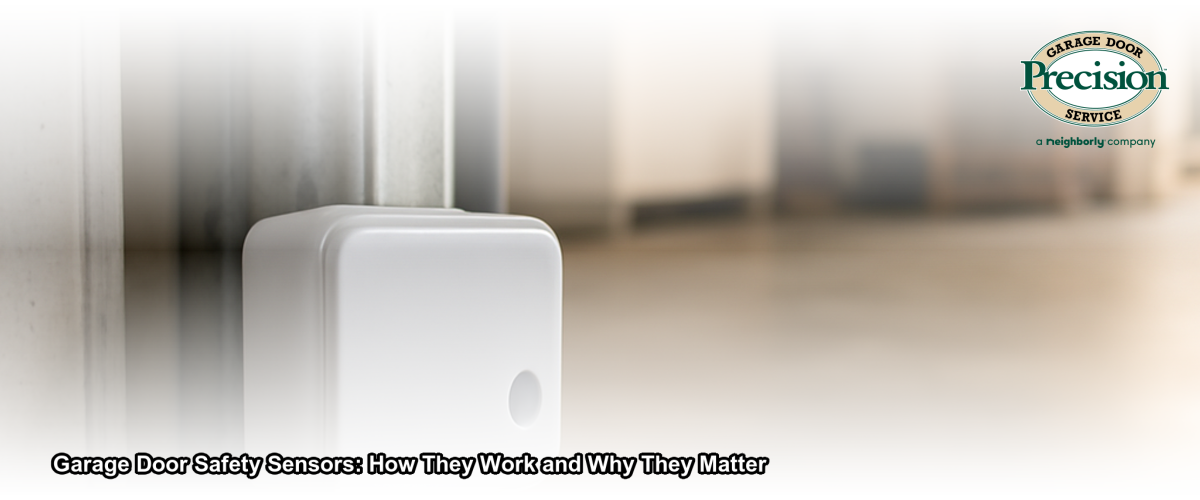
What are garage door safety sensors and what do they do?
Garage door safety sensors — also called safety eyes or photo-eye sensors — are a pair of small devices mounted near the bottom of your garage door tracks that detect obstructions and prevent the door from closing on a person, pet, or object. One sensor sends an invisible infrared beam across the opening; the other receives it. If anything breaks that beam while the door is closing, the door automatically stops and reverses.
Federal law has required safety sensors on all automatic garage door openers sold in the United States since 1993, making them one of the most important safety features on your entire door system. At Precision Door Service of Central & South Jersey, our certified technicians inspect safety sensors on every service call — because a sensor that looks fine can still be misaligned, dirty, or failing.
How exactly do garage door safety sensors work?
Garage door safety sensors work through a simple but reliable process: the sending sensor (usually indicated by a steady amber light) projects a continuous infrared beam roughly 4 to 6 inches off the ground across the width of the door opening, and the receiving sensor (usually indicated by a steady green light) confirms the beam is uninterrupted. When the beam is broken — by a child, a bicycle, a garbage can, or even a blowing leaf — the opener’s logic board receives an interrupt signal and immediately reverses the door’s direction.
Most modern LiftMaster and Genie openers, both of which Precision Door Service of Central & South Jersey sells and installs, incorporate the sensor circuit into the opener’s safety logic so that if the sensors are disconnected or malfunctioning, the door will refuse to close entirely — a deliberate fail-safe design.
Why is my garage door not closing? Could it be the sensors?
If your garage door goes down a few inches and then immediately reverses, or if the opener’s lights flash repeatedly and the door refuses to move, a misaligned or blocked safety sensor is the most likely cause. The indicator lights tell you a lot: if the receiving sensor’s green light is off or blinking, the beam is not being received cleanly.
Common reasons sensors fail to communicate include:
- Physical misalignment — one or both sensors have been bumped out of position
- Dirt, cobwebs, or moisture on the sensor lenses
- Direct sunlight hitting the receiving sensor and overwhelming the infrared signal
- A frayed or pinched sensor wire along the door track
- A sensor that has simply worn out or failed internally
Here in Ocean and Monmouth Counties, humidity from the coast and bay — especially in communities like Point Pleasant Beach and Brick — can accelerate lens fogging and wire corrosion, making periodic sensor checks a smart habit for local homeowners.
Can I realign or clean garage door sensors myself?
Basic sensor cleaning and minor realignment are tasks most homeowners can handle safely. Use a soft, dry cloth to wipe both sensor lenses, then gently loosen the wing nut or bracket screw holding the misaligned sensor, reposition it until its indicator light glows solid, and retighten. Test the door by placing a cardboard box in the path — the door should reverse upon contact.
However, if cleaning and realignment do not resolve the issue, or if you notice frayed wiring, a cracked sensor housing, or an indicator light that will not stabilize, it is time to call a professional. Wiring repairs and sensor replacements involve working with components connected to your opener’s circuit board, and an incorrect repair can disable the safety function entirely — the opposite of what you want. As we explain in our guide to garage door maintenance and safety inspections, sensors are one of several components that should be verified by an experienced technician at least once a year.
How much does it cost to replace garage door safety sensors?
Sensor replacement at Precision Door Service of Central & South Jersey is a straightforward repair that our certified technicians can typically complete the same day they come out — no need to schedule a return trip. Because pricing depends on the specific opener model and whether wiring needs to be repaired or rerouted, we provide an honest, upfront estimate before any work begins, consistent with our customer-first approach.
What is always included in a sensor service call: a comprehensive safety inspection of the full door system, a clear explanation of what we found and what we recommend, and high-quality replacement parts when a swap is needed. We never recommend a repair you do not need — our goal is to do the right thing for the customer, every time.
What happens if I bypass or disable my garage door sensors?
Disabling or bypassing garage door safety sensors removes a federally mandated safety feature and creates a serious risk of injury or death — particularly to children and pets. A garage door panel can weigh anywhere from 100 to over 400 pounds depending on size and material, and an undetected obstruction can result in catastrophic harm. Beyond the physical danger, bypassing sensors may void your opener’s warranty and could create liability exposure for the homeowner.
If your sensors are preventing the door from closing and you suspect a false trigger, the correct response is to identify and fix the underlying cause — not to override the system. Our technicians serving Toms River, Freehold, Middletown, and communities throughout Central & South Jersey respond to sensor issues promptly, including urgent calls, because we understand this is not a problem you can safely ignore.
How often should garage door safety sensors be inspected?
Garage door safety sensors should be tested monthly by the homeowner and professionally inspected at least once a year as part of a full garage door tune-up and safety inspection. The monthly test takes under a minute: place a small object like a paper towel roll flat on the floor in the door’s path and press the close button — the door must reverse when it contacts the roll.
For homeowners near the Jersey Shore — in towns like Point Pleasant Beach, Manasquan, or Brick — the salt air and seasonal humidity create harsher conditions than inland areas, and an annual professional inspection becomes even more valuable for catching early corrosion or sensor degradation before it becomes a breakdown. See our full guide to garage door maintenance for a complete seasonal checklist.
Does Precision Door Service of Central & South Jersey repair safety sensors?
Yes — safety eye repair and replacement is one of the most common repairs performed by Precision Door Service of Central & South Jersey, with two convenient offices at 225 Chambersbridge Rd. in Brick and 100 Ryders Ln. in Milltown, serving homeowners throughout Ocean, Monmouth, Mercer, and Middlesex Counties. Our experienced technicians carry replacement sensors compatible with LiftMaster, Genie, and other leading opener brands, so most repairs are completed on the first visit.
Locally serving Central & South Jersey since 2000, Precision Door Service has helped more than 140,000 homeowners — and counting — keep their garage doors operating safely and reliably. We are here when you need us, anytime, every time, with 24/7 availability for urgent issues. You can reach us at 732-836-9090 or email us at [email protected]. Remember: Precision is always the right decision.
This guide was prepared by the certified technicians at Precision Door Service of Central & South Jersey, locally serving Ocean, Monmouth, Mercer, and Middlesex Counties since 2000.
Frequently Asked Questions
Why does my garage door reverse before it hits the ground?
If your garage door reverses before fully closing, the most common cause is a misaligned or obstructed safety sensor. Check that both sensor indicator lights are solid (amber on the sender, green on the receiver) and wipe the lenses clean. If the problem persists, call a professional — a failing sensor circuit should never be bypassed.
How do I know if my garage door sensors are working properly?
Place a small object like a rolled-up paper towel flat on the floor in the door’s path and press the close button. The door should reverse when it contacts the object. Also confirm both sensor lights are glowing solid — a blinking or dark light means the beam is not completing cleanly and the sensors need attention.
Can humidity or salt air near the Jersey Shore affect my garage door sensors?
Yes. The coastal humidity and salt air common in towns like Brick, Point Pleasant Beach, and Toms River can cause sensor lenses to fog and sensor wiring to corrode faster than in inland areas. Annual professional inspections are especially recommended for homeowners near the ocean or bay.
Will a technician be able to fix my garage door sensors the same day?
In most cases, yes. Precision Door Service of Central & South Jersey technicians carry replacement sensors compatible with LiftMaster, Genie, and other major brands, so same-day repair is typical. They will also perform a full safety inspection while on site.
Is it safe to use my garage door if the sensors are not working?
No — operating a garage door with non-functional safety sensors is dangerous and removes a federally required safety feature. A garage door can weigh well over 100 pounds, and without sensors, it will not reverse if a person, pet, or object is in its path. Contact a professional for same-day service rather than using the door in this condition.