
What Are Garage Door Safety Sensors and What Do They Do?
Garage door safety sensors are small electronic devices mounted near the base of your garage door tracks that detect objects in the door’s path and automatically stop or reverse the door to prevent injury or damage. They are a federally mandated safety feature — the U.S. government has required them on all new automatic garage door openers sold since 1993. If your home has an automatic opener, it has these sensors.
At Precision Door Service of Central & South Jersey, our certified technicians inspect safety sensors as part of every service call and comprehensive safety inspection — because a sensor that fails silently is one of the most common causes of garage door-related injuries.
How Do Garage Door Photo-Eye Sensors Actually Work?
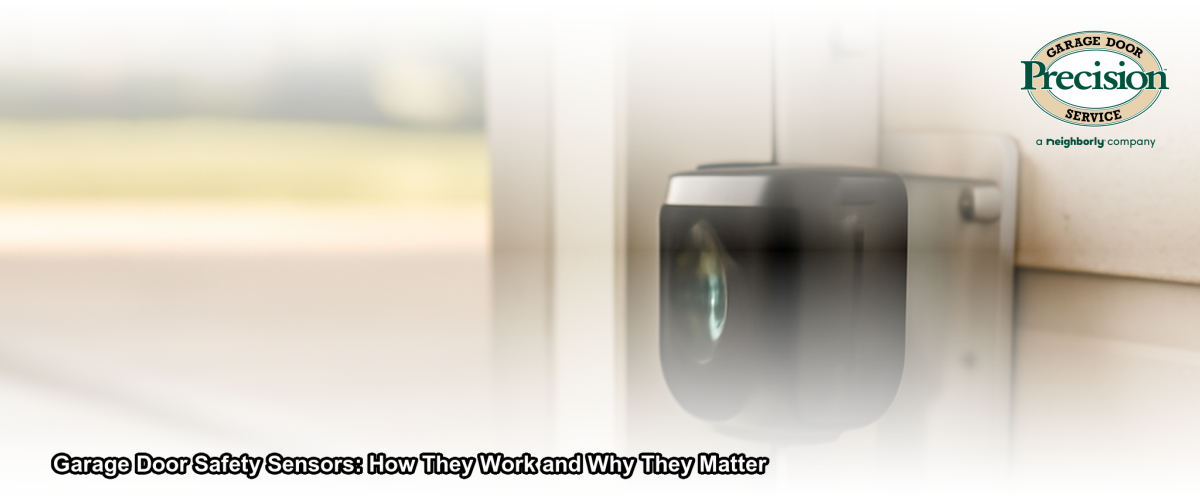
Garage door safety sensors work as a matched pair: one unit sends an invisible infrared beam across the width of the door opening to a receiving unit on the opposite side, and if anything breaks that beam while the door is closing, the opener immediately stops and reverses the door. The two sensors — commonly called photo-eye sensors or safety eyes — are typically mounted 4 to 6 inches off the ground on each side of the door track.
The sending unit emits a continuous infrared signal. The receiving unit monitors that signal. When the beam is unobstructed, both sensors show a steady indicator light (usually green on the receiver and amber on the sender). When the beam is interrupted — by a child, a pet, a bicycle, or even a cardboard box — the opener logic board reads the break and triggers an immediate reversal. No manual input required.
Most modern openers from LiftMaster and Genie, which Precision Door Service installs and services throughout Ocean, Monmouth, Mercer, and Middlesex Counties, incorporate this sensor system directly into the opener’s safety circuit. As covered in our full guide to garage door opener types, the sensor wiring runs from each photo-eye unit back to the opener motor head mounted on the ceiling.
Why Do Garage Door Sensors Stop Working?
The most common reasons garage door safety sensors fail are misalignment, dirty lenses, damaged wiring, and direct sunlight interference — and most of these problems appear gradually rather than all at once. A sensor that is only slightly out of alignment may work intermittently, which is actually more dangerous than a sensor that fails completely, because the door may close unexpectedly.
- Misalignment: Sensors get nudged out of position by foot traffic, lawn equipment, or a door being opened manually. When the sending and receiving units are no longer aimed directly at each other, the beam breaks and the door refuses to close.
- Dirty or obstructed lenses: Dust, cobwebs, moisture, and New Jersey’s coastal humidity near areas like Point Pleasant and Seaside can coat the sensor lens and weaken or block the signal.
- Wiring damage: Wires running along the track can fray over time, especially in garages that see heavy use or temperature swings common along the Jersey Shore.
- Sunlight interference: In late afternoon, direct sunlight can temporarily overpower the infrared receiver, causing the door to behave as if the beam is broken even when nothing is in the path.
- Worn or failing sensor units: Sensors have a finite lifespan. After years of exposure to moisture, temperature cycles, and vibration, the internal components can degrade.
How Can You Tell If Your Garage Door Sensors Are Malfunctioning?
The clearest sign that your safety sensors are malfunctioning is a garage door that reverses immediately after touching the floor or refuses to close at all, even when no obstacle is present. Other warning signs include a blinking or flickering indicator light on the sensor unit, the door only closing when you hold down the wall button continuously, or the door closing inconsistently — working fine one day and refusing to close the next.
If your opener’s indicator light on the ceiling unit is blinking a specific number of times in a pattern, that is a diagnostic code pointing to a sensor fault — consult your opener’s manual or call Precision Door Service of Central & South Jersey at 732-836-9090 for a same-day diagnosis. Our technicians carry the high-quality parts needed to resolve most sensor issues in a single visit.
Can You Fix Misaligned Garage Door Sensors Yourself?
Homeowners can safely attempt to realign sensors that have simply been nudged out of position — it requires no tools and no electrical work. Gently rotate each sensor unit within its bracket until both indicator lights show steady (not blinking), then tighten the wing nut or mounting screw to hold the position. Wipe the lenses with a clean, dry cloth before testing.
However, if the lights remain blinking after realignment, or if the wiring is damaged, or if sensors need to be replaced, that work is best handled by experienced technicians. Incorrect wiring or mismatched replacement sensors can create a door that appears safe but bypasses the protection entirely — which defeats the entire purpose. When there is any doubt, a professional safety inspection from Precision Door Service is the right call. We have been locally serving Central & South Jersey since 2000 and have helped more than 140,000 homeowners get their doors operating safely.
What Happens During a Professional Sensor Inspection?
During a professional sensor inspection, a certified technician tests the full safety circuit — not just the sensor lights. At Precision Door Service, every service call includes a comprehensive safety inspection that covers the sensors, the automatic reversal mechanism, the manual release, the opener logic board connection, and the physical mounting of both sensor units.
The technician will verify that the door reverses correctly when an object breaks the beam, confirm that the mechanical auto-reverse (a separate safety feature that triggers when the door meets physical resistance) is also calibrated correctly, and check that sensor wiring is secure from the unit all the way back to the opener. If replacement sensors are needed, we use high-quality parts and explain every recommendation clearly before any work begins — no surprises, no pressure.
How Much Does It Cost to Repair or Replace Garage Door Safety Sensors in Central and South Jersey?
Sensor repair and replacement costs vary depending on whether the issue is a simple realignment, a wiring repair, or full sensor replacement — but it is one of the more straightforward and affordable garage door repairs available. For exact pricing on your specific situation, Precision Door Service of Central & South Jersey provides honest, upfront estimates before any work begins, and our technicians can perform most sensor repairs the same day they come out.
Financing is available through GreenSky via a simple online application if you are combining sensor work with a larger repair or a new garage door opener installation. We accept all major credit cards, checks, and cash. For new garage door or entry door installations, we also offer free estimates.
What Else Should You Expect With Sensor Service — Hidden Costs and What Is Included?
There are no hidden surprises when you work with Precision Door Service. Our technicians arrive on time, perform a comprehensive safety inspection of your entire door system (not just the sensors you called about), explain what they find in plain language, and give you a clear recommendation before touching anything. You decide what work to authorize.
What is included in a standard sensor service visit: full photo-eye alignment check, lens cleaning, wiring inspection, beam break test, mechanical auto-reverse verification, and a review of the full door system for any other worn components. If parts are needed beyond what the technician has on the truck, we will tell you upfront and schedule the follow-up promptly. We do not upsell services you do not need — our goal is to do the right thing for the customer, every time.
How Often Should Garage Door Safety Sensors Be Tested?
Safety sensors should be tested at least once a month and professionally inspected once a year. The monthly test takes about 30 seconds: place a cardboard box or roll of paper towels in the door’s path and press the close button — the door should reverse immediately upon contact with the object or when the beam is broken. If it does not reverse cleanly, call a technician.
Annual professional maintenance — as covered in our garage door maintenance guide — catches issues that visual checks miss, including gradual sensor drift, wiring degradation, and early signs of component wear. In coastal areas of Ocean County such as Brick, Point Pleasant, and Toms River, salt air accelerates corrosion on sensor hardware, making annual inspections especially worthwhile. Precision is always the right decision when it comes to keeping your family safe.
This guide was prepared by the experienced technicians at Precision Door Service of Central & South Jersey, locally serving homeowners in Ocean, Monmouth, Mercer, and Middlesex Counties since 2000.
Frequently Asked Questions
Why does my garage door reverse before it hits the ground?
This usually means the safety sensors are misaligned, have dirty lenses, or are being triggered by sunlight — causing the opener to detect a false obstruction. Check that both sensor indicator lights are steady (not blinking), wipe the lenses clean, and gently realign the units. If the problem persists, call a certified technician to inspect the wiring and sensor circuit.
How do I know if my garage door sensor is broken or just misaligned?
A blinking or flickering indicator light on the sensor almost always means misalignment or a dirty lens, while a sensor with no light at all typically points to a wiring issue or a failed unit. Try realigning the sensors by rotating each one until both lights are steady — if that does not resolve it, the sensor or its wiring likely needs professional repair or replacement.
Is it safe to bypass garage door safety sensors to get the door to close?
No — bypassing safety sensors removes the primary protection against the door striking a person, child, or pet. The only safe workaround while waiting for a repair is to operate the door using the wall button held continuously, which activates a manual override mode built into most openers. Have the sensors repaired before returning to normal automatic operation.
How long do garage door safety sensors last?
Garage door safety sensors typically last 10 years or more under normal conditions, but coastal environments with salt air — common in Ocean County towns like Brick, Toms River, and Point Pleasant — can shorten that lifespan due to corrosion on the hardware and mounting brackets. Annual professional inspections help catch degradation before sensors fail unexpectedly.
Does Precision Door Service of Central and South Jersey fix safety sensors the same day?
In most cases, yes — Precision Door Service technicians carry high-quality replacement parts on their trucks and can diagnose and repair safety sensor issues during the initial service visit. Call 732-836-9090 to schedule, and a technician will arrive on time, perform a full safety inspection, and explain exactly what is needed before any work begins.