What makes choosing a garage door for a detached garage different from an attached one?
A detached garage door requires more deliberate planning than an attached garage door because the structure stands on its own — without the insulation benefit of shared walls with a heated home. That changes how you weigh insulation values, material durability, and opener power. Precision Door Service of Central & South Jersey has helped more than 140,000 homeowners across Ocean, Monmouth, Mercer, and Middlesex Counties make exactly this call, and the considerations for a standalone structure are genuinely different.
A detached garage is also more exposed to the elements on all sides. In areas like Brick Township, Toms River, and Point Pleasant — where salt air, coastal humidity, and nor’easters are part of life — material choice becomes even more consequential. What works on a garage tucked against a heated house may rust, warp, or lose its seal much faster when it’s freestanding in a New Jersey coastal yard.
What garage door styles work best for a detached garage?
Sectional doors are the most practical and popular style for detached garages because they operate vertically, require minimal driveway clearance, and seal tightly against the frame — a real advantage for a structure that faces weather on every side.
Beyond the mechanical type, the aesthetic style should reflect how the garage will be used and how it relates to your home:
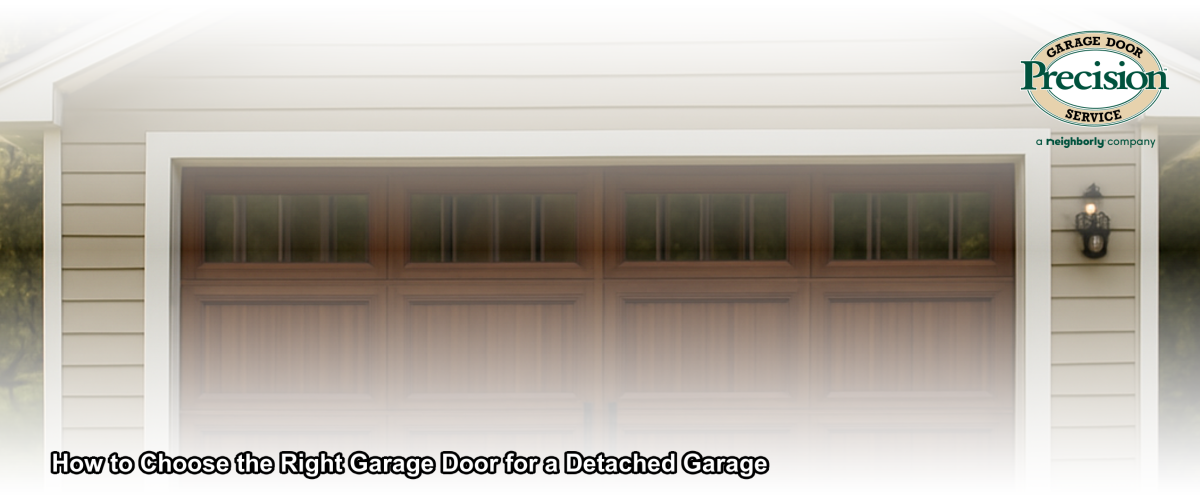
- Carriage-house style — highly popular in Central and South Jersey neighborhoods; mimics swing-out doors but operates like a standard sectional. Works especially well when the detached garage is visible from the street.
- Traditional raised-panel — clean, cost-effective, and widely available in steel and composite materials. A solid choice for utility-focused garages.
- Contemporary flush-panel — increasingly popular for modern home builds; pairs well with horizontal siding and aluminum accents.
- Full-view aluminum — ideal when the detached garage doubles as a workshop or studio where natural light matters.
Precision Door Service carries and installs doors from leading manufacturers including Amarr, C.H.I., Clopay, and Fimbel, so there is a wide range of styles, panel designs, window options, and colors available at no obligation — free estimates are always included.
What is the best garage door material for a detached garage in New Jersey?
Steel is the most durable and lowest-maintenance material for most New Jersey detached garages, but the right gauge and finish coating matters enormously in coastal areas where salt air accelerates rust.
Here is how the common materials compare for a standalone structure in Central and South Jersey:
- Steel (24-gauge or heavier) — strongest against impact and wind load; look for galvanized steel with a factory primer and paint system if your detached garage is within a few miles of the ocean or a bay. Our brand guide notes this as a top customer question: material choice near the shore is a real and important distinction.
- Fiberglass / composite — naturally rust-resistant, a strong choice for Ocean County and Monmouth County coastal properties. Lighter weight than steel but may fade over time without UV-resistant finishes.
- Wood and wood composite — beautiful for carriage-house looks, but solid wood demands regular sealing and painting in New Jersey’s humid summers and freeze-thaw winters. Wood composite offers a middle ground with less maintenance.
- Aluminum — lightweight and rust-proof, but dents more easily and offers minimal insulation on its own. Best suited for mild-climate applications or contemporary full-view designs where appearance is the priority.
If your detached garage faces the water or is located in Point Pleasant Beach, Manahawkin, or anywhere along the Jersey Shore corridor, ask about corrosion-resistant finishes and hardware upgrades — that conversation is free and can save you significant cost down the road.
Do I need an insulated garage door on a detached garage?
You need an insulated garage door on a detached garage if you plan to heat or cool the space, use it as a workshop or finished room, or if you simply want to reduce energy loss through the largest opening in the structure.
Insulation in garage doors is rated by R-value — the higher the number, the better the thermal resistance. For an unheated storage-only detached garage, a basic R-6 to R-9 door is usually sufficient. For a conditioned or finished garage space — a home gym, workspace, or hobby room — aim for R-13 to R-18 or higher. Two-layer (steel + polystyrene) construction offers a moderate upgrade; three-layer (steel + polyurethane + steel) is the premium choice for best insulation and structural rigidity.
Keep in mind that a detached garage in New Jersey loses heat through all four walls and the roof — not just the door. Insulating the door is a meaningful step, but it works best alongside proper wall and ceiling insulation. As covered in our broader new door installation resources, the door’s thermal performance is one factor in the larger building envelope equation.
What size garage door do I need for a detached garage?
The standard garage door width for a single-car detached garage is 9 feet wide by 7 feet tall; a double-car detached garage typically uses a 16-foot wide by 7-foot tall door or two separate 9-foot doors side by side.
Measure the rough opening — the framed-in space — carefully before ordering, not just the finished opening. If your detached garage was built several decades ago, non-standard openings are common and a professional measurement is worth scheduling before committing to a door size. Precision Door Service of Central & South Jersey provides free estimates that include an accurate site measurement, so there are no surprises at installation.
Also account for headroom (the space between the top of the opening and the ceiling) and side-room clearance. Older detached garages sometimes have limited headroom that requires a low-headroom track kit — something to identify early in the process.
What garage door opener should I choose for a detached garage?
For most detached garages, a belt-drive or chain-drive opener from LiftMaster or Genie is the right starting point — but the best choice depends on how the structure is used and whether it has electrical power and Wi-Fi access.
- Belt-drive — quietest operation; ideal if the detached garage is close to a bedroom window or outdoor living space.
- Chain-drive — louder but highly reliable and cost-effective; a strong choice for utility garages where noise is not a concern.
- Wall-mounted (jackshaft) — mounts beside the door rather than overhead; frees up ceiling space and works well in garages with limited headroom or high ceilings used for storage.
- Battery backup — particularly valuable for a detached garage, since power outages affect it just as they affect the main house, and you may not be able to access a manual release as easily in the dark.
- Wi-Fi-enabled openers — allow remote open/close and real-time alerts from your phone, useful for monitoring a detached garage that isn’t directly adjacent to the home.
Our experienced technicians — including Lead Technician C.J. and the full installation team — can walk you through opener options at no charge during your free estimate visit. See our full guide to garage door opener types for a deeper breakdown of each drive system.
What are the hidden costs or extras I should expect when replacing a detached garage door?
Beyond the door panel price itself, a complete detached garage door project typically involves several additional components that affect your total investment.
- Hardware and track system — springs, cables, rollers, and hinges are usually replaced along with a new door installation to ensure everything is properly matched and rated for the new door weight.
- Opener compatibility — an older opener may not be compatible with a new door, especially if you are upgrading to a heavier insulated model. Factor in opener replacement or upgrade costs if your existing unit is more than 10–15 years old.
- Framing or structural repairs — detached garages, especially older ones, sometimes have rotted or out-of-square framing around the opening that needs correction before a new door can be properly installed.
- Weatherstripping and bottom seal — these are typically included with a new door installation but confirm what is covered before signing off on any estimate.
- Permit requirements — New Jersey municipalities vary; Brick Township, Jackson, and other Ocean County towns may require a permit for a full door replacement versus a like-for-like swap. Ask your installer.
Precision Door Service provides free estimates with transparent, itemized recommendations — no pressure, no surprises, and no obligation. Financing is available through GreenSky with an easy online application if you want to spread the cost of a full installation.
How do I maintain a new garage door on a detached garage?
A detached garage door should be lubricated with a garage-door-specific lubricant — not WD-40 — on springs, hinges, rollers, and the opener chain or belt at least once or twice a year, ideally before winter and again in the spring after a New Jersey freeze-thaw season.
Because a detached garage is more exposed to wind, rain, and temperature swings than an attached one, the bottom seal and weatherstripping should be inspected annually for cracks or compression loss. Salt air along the Shore communities of Ocean and Monmouth Counties can also corrode hardware faster, so wipe down exposed metal components and check for rust spots each season. A professional maintenance and safety inspection from Precision Door Service — offered as a standalone service — can catch worn springs, fraying cables, and misaligned safety eyes before they become emergency repairs. As we note in our maintenance resources, garage door springs and rollers have a finite lifespan, and catching wear early is always the more cost-effective path.
This guide was prepared by Precision Door Service of Central & South Jersey, your trusted local garage door experts serving Brick Township and communities throughout Ocean, Monmouth, Mercer, and Middlesex Counties, NJ — locally serving Central & South Jersey since 2000.
Frequently Asked Questions
Can I put any standard garage door on a detached garage?
Most standard sectional garage doors fit detached garages, but you need to verify the rough opening size, available headroom, and side-room clearance — older detached garages often have non-standard framing. A free on-site estimate from Precision Door Service of Central & South Jersey will confirm the right fit before any door is ordered.
What is the best garage door material for a detached garage near the Jersey Shore?
Galvanized steel with a factory-coated finish or fiberglass composite are the top choices for detached garages near the ocean or bay in Ocean County and Monmouth County, NJ — both resist the salt air and humidity that accelerate rust and warping on untreated steel or solid wood doors.
Do I need a higher R-value insulated door for a detached garage?
If your detached garage is heated, used as a workspace, or finished as a living area, aim for R-13 or higher; an unheated storage garage can get by with R-6 to R-9. The detached structure’s exposed walls make door insulation a more noticeable factor than in an attached garage.
Does Precision Door Service install garage doors on detached garages?
Yes — Precision Door Service of Central & South Jersey installs new garage doors on both attached and detached garages throughout Ocean, Monmouth, Mercer, and Middlesex Counties, with free estimates and professional installation from experienced technicians.
Is a Wi-Fi garage door opener worth it for a detached garage?
A Wi-Fi-enabled opener is especially useful for a detached garage because you can monitor and control the door remotely from your phone, receive open or close alerts, and verify the door is secured without walking across the property — LiftMaster and Genie models with this feature are available through Precision Door Service.