Why Does Regular Garage Door Panel Maintenance Matter?
Routine cleaning and maintenance of your garage door panels protects one of your home’s most visible — and most used — surfaces from premature wear, rust, fading, and costly damage. Garage door panels are exposed to rain, salt air, UV rays, road spray, and temperature swings year-round, and in coastal areas like Brick, Point Pleasant Beach, and Manahawkin, that exposure is significantly more aggressive than in inland regions. A consistent maintenance routine can extend the life of your door by years and keep it looking sharp.
At Precision Door Service of Central & South Jersey, our experienced technicians have helped more than 140,000 homeowners across Ocean, Monmouth, Mercer, and Middlesex Counties keep their garage doors operating safely and looking great — and it nearly always starts with the basics: clean panels and well-lubricated hardware.
How Often Should You Clean Your Garage Door Panels?
You should clean your garage door panels at least twice a year — once in the spring after winter road salt and grime has built up, and once in the fall before cold weather arrives. Homeowners in coastal communities along the Jersey Shore, including Toms River, Point Pleasant Beach, and Manahawkin, should consider cleaning every three to four months, because salt air accelerates corrosion on metal panels and degrades paint and finish on wood and composite doors faster than in inland areas like Princeton or Piscataway.
If your door faces a busy road or your driveway runs close to a highway, more frequent cleaning — as often as monthly — will prevent road film and chemical residue from bonding to the panel surface.
What Supplies Do You Need to Clean Garage Door Panels?
For most residential garage door panels, you only need a few basic supplies: a bucket of warm water, a mild dish soap or dedicated car-wash soap, a soft-bristle brush or non-abrasive sponge, and a garden hose for rinsing. Avoid pressure washers set above low pressure, abrasive scrubbing pads, and harsh chemical cleaners — these can strip paint, scratch steel, or force water into panel seams where it causes rust or swelling in wood-core doors.
- Warm water and mild dish soap or car-wash soap
- Soft-bristle brush or non-abrasive sponge
- Garden hose with a standard spray nozzle
- Microfiber towels or chamois for drying (optional but recommended)
- Automotive paste wax or UV-protectant spray for finishing steel or fiberglass panels
How Do You Clean Steel Garage Door Panels Correctly?
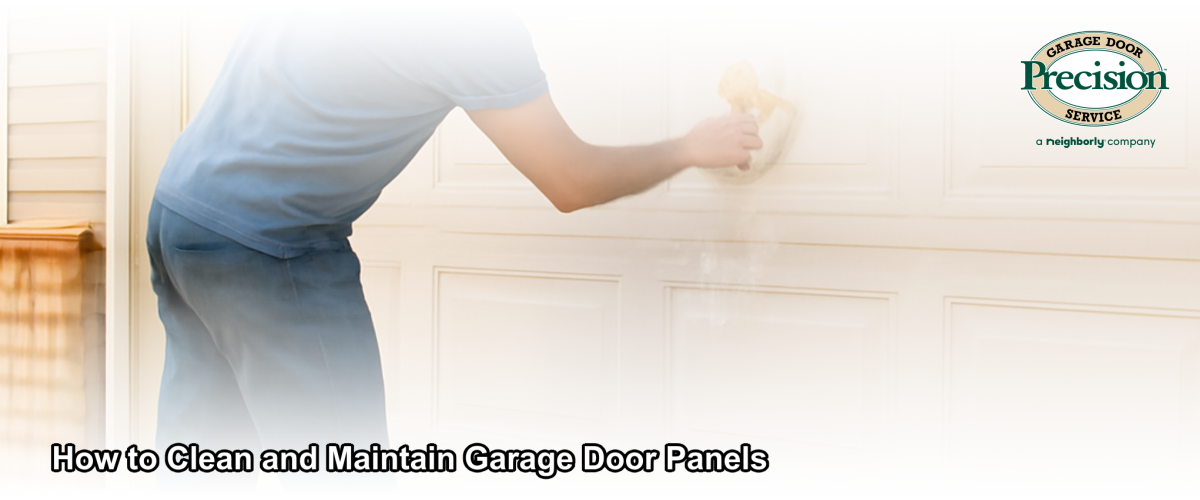
Steel garage door panels should be washed from the bottom up using a soapy sponge or brush, then rinsed thoroughly from the top down to avoid streaking. Start by rinsing loose dirt and debris with a hose, apply your soapy solution in sections, scrub gently along the panel grooves, and rinse completely before the soap dries. Leaving soap residue on steel accelerates oxidation, especially in the salty, humid air along the Jersey Shore coast.
Once the door is clean and dry, apply a thin coat of automotive paste wax or a spray-on UV protectant to the panel surface. This step adds a protective barrier against salt air, UV fading, and moisture — a small investment of time that significantly extends the finish life of a steel door. As covered in our guide to garage door materials, insulated steel doors with a factory-applied finish benefit most from this protective step.
How Do You Maintain Wood and Wood-Composite Garage Door Panels?
Wood and wood-composite panels require gentle cleaning with a slightly damp cloth or soft sponge — never soaking the surface with a hose, which can cause warping, swelling, and paint bubbling over time. Use a mild, diluted wood-safe cleaner and wipe in the direction of the wood grain. After cleaning, inspect the surface carefully for chipping paint, cracks in the finish, or soft spots that indicate moisture penetration.
Re-painting or re-staining wood panels every 1 to 2 years — or more frequently in coastal townships like Point Pleasant Beach or Manahawkin where salt air is relentless — is the single most important maintenance step for wood doors. Bare or cracked wood absorbs moisture rapidly, leading to warping and rot that can make the door structurally unsound. If you notice soft or spongy areas in the panel, that damage may be beyond cleaning; our team can assess whether repair or replacement is the right call.
What Else Should Be Done During a Garage Door Panel Maintenance Visit?
Panel cleaning is most effective when combined with a broader inspection of moving parts, hardware, and weatherstripping — because a clean door with worn-out rollers or a failing bottom seal is still a door headed for a breakdown. When Precision Door Service of Central & South Jersey performs a maintenance visit, our certified technicians check and address the following alongside the visual condition of the panels:
- Lubrication of springs, rollers, hinges, and tracks with a professional-grade lubricant
- Inspection of bottom weatherseal and side seals for cracking, gaps, or deterioration
- Check of panel alignment — gaps between panels or bowing can indicate hinge or track issues
- Safety inspection of cables, springs, and opener hardware
- Balance test to confirm the door lifts evenly and without motor strain
As a general rule, a full preventative maintenance and safety inspection should be scheduled once a year — or twice a year for high-use doors, doors in coastal communities, or older doors approaching the 10-to-15-year mark on original hardware. See our full guide to garage door safety inspections for a complete breakdown of what a professional tune-up covers.
Can You Remove Rust or Stains From Garage Door Panels Yourself?
Light surface rust on steel panels can often be addressed at home using a rust-dissolving product applied to a soft cloth, gently rubbed over the affected spot, rinsed clean, and immediately followed by a touch-up paint or automotive primer to seal the bare metal. Do not leave bare steel exposed after rust removal — even a few weeks of unprotected exposure in humid Central or South Jersey weather is enough for rust to return. For rust that has penetrated through the panel surface or created bubbling and pitting, panel replacement is typically the more cost-effective long-term solution.
Stubborn mold, mildew, or algae stains — common on shaded garage doors in townships like Monroe or Middletown where tree canopy keeps the door damp — can be treated with a diluted white vinegar solution or a mildew-specific outdoor cleaner. Apply, let dwell for a few minutes, scrub gently, and rinse completely.
When Should You Call a Professional Instead of Cleaning Yourself?
Call a professional when your cleaning reveals structural damage — dented, cracked, or warped panels that affect how the door seals or operates, widespread rust that has compromised the panel surface, or visible gaps between panels that were not there before. These are signs the door needs more than a wash; they point to panel damage, hinge failure, or track misalignment that requires a trained eye and the right parts to correct.
Precision Door Service of Central & South Jersey has been locally serving Central & South Jersey since 2000, with two offices — 225 Chambersbridge Rd. in Brick and 100 Ryders Ln. in Milltown — to serve homeowners across Ocean, Monmouth, Mercer, and Middlesex Counties. Our experienced technicians are here when you need us, anytime, every time — and we do the right thing for the customer, every visit. Call us at 732-836-9090 to schedule a maintenance visit or to get a free estimate on a new door if yours has seen better days.
This guide was prepared by the experienced technicians at Precision Door Service of Central & South Jersey, trusted local garage door experts serving Brick, Toms River, Freehold, Princeton, and communities throughout Ocean, Monmouth, Mercer, and Middlesex Counties for more than 25 years.
Frequently Asked Questions
How often should I clean my garage door panels?
Most homeowners should clean their garage door panels at least twice a year — spring and fall. If you live near the Jersey Shore in communities like Brick, Point Pleasant Beach, or Manahawkin, clean every three to four months because salt air accelerates corrosion and finish degradation.
What is the best cleaner for garage door panels?
Warm water with a mild dish soap or car-wash soap applied with a soft-bristle brush or non-abrasive sponge works well for most steel, aluminum, and fiberglass panels. Avoid pressure washers at high settings and harsh chemical cleaners, which can strip paint and damage panel finishes.
How do I protect steel garage door panels from rust?
After washing and drying steel panels, apply a coat of automotive paste wax or a UV-protectant spray to seal out moisture and salt air. For any spots where rust has appeared, treat with a rust-dissolving product and immediately seal with touch-up paint or primer — never leave bare steel exposed.
Can I use a pressure washer on my garage door panels?
A pressure washer on a low setting can be used carefully on steel or fiberglass panels, but it is not recommended for wood or wood-composite doors, where high-pressure water forces moisture into seams and causes warping, swelling, and paint failure. A standard garden hose and soft brush are safer for most panel types.
How do I know when a garage door panel needs to be replaced instead of cleaned?
If cleaning reveals deep rust that has pitted through the panel surface, structural cracks or warping, visible gaps between panels that weren’t there before, or soft spots in a wood panel indicating rot, those are signs that replacement is needed. Precision Door Service of Central & South Jersey can assess panel condition and recommend the most cost-effective solution.