Why does the garage door auto-reverse safety feature matter?
The auto-reverse safety feature is one of the most important safety mechanisms on any garage door — it causes the door to stop and reverse direction if it contacts a person, pet, or object while closing. Federal law has required this feature on all garage door openers sold in the United States since 1993, and a door that fails this test is a serious injury risk, particularly for children and pets.
At Precision Door Service of Central & South Jersey, our certified technicians see preventable accidents that could have been avoided with a simple monthly test. Testing takes less than two minutes and requires no special tools.
What are the two types of auto-reverse systems, and how does each work?
Every modern garage door opener has two separate auto-reverse systems that work together: a mechanical (contact) auto-reverse and a photoelectric sensor (safety eye) auto-reverse. Both must function correctly for your door to be considered safe.
- Mechanical auto-reverse: Detects physical contact — if the closing door touches an object on the ground, the opener senses the resistance and immediately reverses the door upward.
- Photoelectric sensors (safety eyes): These are the two small sensors mounted near the bottom of each garage door track, usually about 4 to 6 inches off the ground. They project an invisible infrared beam across the door opening. If anything breaks that beam while the door is closing, the door reverses automatically without needing to touch the object at all.
Both systems can fail independently, which is why you should test them separately — and regularly.
How do you test the mechanical auto-reverse on a garage door?
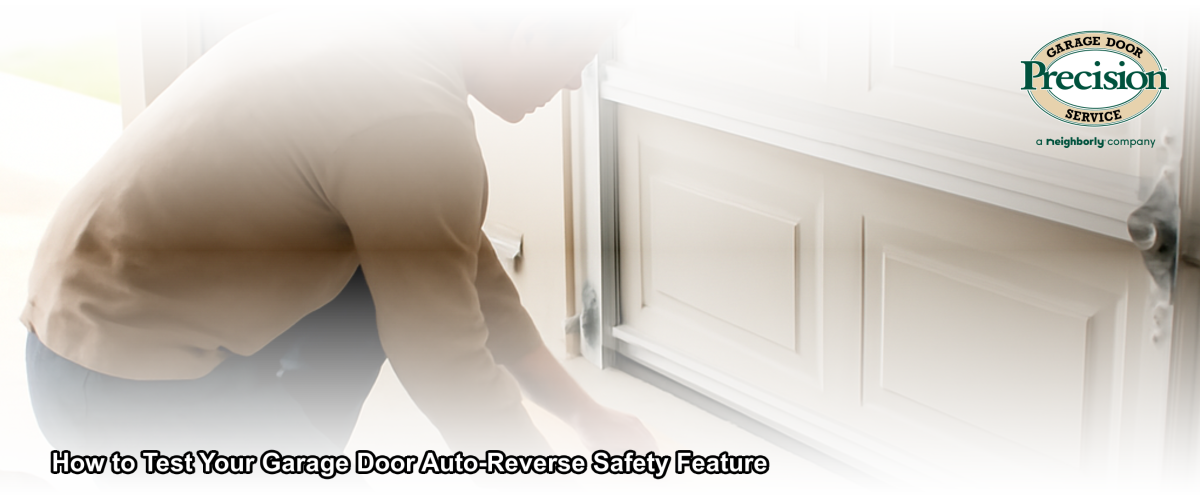
To test the mechanical auto-reverse, place a flat, rigid object — a 2×4 piece of lumber laid flat is the classic method — on the ground centered in the doorway. Press the button to close the door. When the bottom of the door contacts the board, the opener should immediately reverse the door back to the fully open position. If the door hesitates, grinds, or does not reverse within 1 to 2 seconds of contact, the mechanical sensitivity setting needs adjustment or the opener may need service.
Never use your foot or any part of your body to test the mechanical auto-reverse. The wood board method is the standard recommended by the Consumer Product Safety Commission and by our experienced technicians here in Brick Township, NJ.
How do you test the photoelectric safety eye sensors?
To test the photoelectric sensors, start closing the door and then wave a long object — a broom handle or mop works well — through the sensor beam near the floor while the door is moving downward. The door should immediately reverse without making contact with the object. If the door continues closing or does not respond, the sensors may be misaligned, dirty, or faulty.
You can also simply watch the sensor indicator lights. On most LiftMaster and Genie openers (both of which Precision Door Service carries and services), one sensor light is typically green (receiving sensor) and one is amber or red (sending sensor). Both lights should be steady — not blinking. A blinking or off light usually means the sensors are out of alignment or obstructed.
How often should homeowners in Central and South Jersey test their auto-reverse feature?
The Consumer Product Safety Commission recommends testing your garage door’s auto-reverse at least once a month. Our team at Precision Door Service of Central & South Jersey — locally serving Central & South Jersey since 2000 — recommends making it part of the same monthly routine as checking smoke detector batteries, especially in households with young children or pets.
Ocean County and Monmouth County homeowners should also be aware that the coastal environment accelerates wear on mechanical components. Salt air and humidity can corrode sensor housings and wiring connections faster than inland locations, which makes regular testing even more important in towns like Brick, Point Pleasant, Point Pleasant Beach, and Manahawkin.
What should you check if the auto-reverse test fails?
If your door fails either test, do not continue using the door until the problem is resolved — this is a genuine safety hazard. Here is what to look at before calling a professional:
- Sensor alignment: Gently realign both sensors so they face each other directly. The indicator lights should both return to steady when alignment is correct.
- Sensor lenses: Wipe the small lenses on both sensors with a clean, dry cloth. Dust, spider webs, and moisture from New Jersey humidity are common culprits.
- Wiring: Check for any visible damage, pinching, or disconnection in the sensor wires running along the door track.
- Mechanical sensitivity: Most openers have an adjustment screw or dial for down-force sensitivity. Consult your opener’s manual — over-tightening this setting is a common reason the door does not reverse quickly enough on contact.
If you have checked all of the above and the door still fails, the opener or sensors likely need professional repair. As covered in our garage door opener repair guide, a failing opener can present multiple symptoms at once — auto-reverse failure is often the first warning sign.
What hidden costs or risks come with ignoring a failed auto-reverse test?
Ignoring a failed auto-reverse system is not just a safety risk — it can also create financial and legal exposure. A garage door that injures someone because a known safety system was not functioning can result in significant liability. Beyond that, sensor and opener issues caught early are almost always less expensive to fix than the cascading damage that can result from a door that closes on a vehicle, a pet, or a person.
At Precision Door Service, our certified technicians perform a comprehensive safety inspection with every repair visit. If sensors are misaligned, damaged, or near the end of their service life, we will explain exactly what we found and what we recommend — honestly, without pressure. We use high-quality replacement parts and stand behind our work, because doing the right thing for the customer is how we earn their business and their trust.
When should you call a professional instead of fixing it yourself?
Call a professional garage door technician if: the sensors are correctly aligned and clean but still not functioning, the opener does not respond to the sensitivity adjustment, you notice visible damage to the wiring or sensor brackets, or the door reverses erratically even when nothing is in its path. These are signs of an electrical or opener problem that goes beyond a simple adjustment.
Precision Door Service of Central & South Jersey serves homeowners throughout Ocean, Monmouth, Mercer, and Middlesex Counties — including Toms River, Brick, Jackson, Freehold, Middletown, Princeton, Edison, and surrounding communities. We are available 24/7, here when you need us, anytime, every time. You can also ask about our garage door maintenance and safety inspection service, which covers auto-reverse testing, lubrication, hardware inspection, and a full operational check in a single visit.
This guide was prepared by the experienced technicians at Precision Door Service of Central & South Jersey, locally serving Ocean, Monmouth, Mercer, and Middlesex Counties since 2000.
Frequently Asked Questions
How do I test my garage door’s auto-reverse feature?
Place a flat 2×4 board on the ground in the center of the doorway, then press the button to close the door. The door should reverse automatically within 1 to 2 seconds of touching the board. Separately, wave a broom handle through the photoelectric sensor beam near the floor while the door is closing — it should also reverse immediately without making contact.
What do blinking lights on my garage door sensors mean?
Blinking indicator lights on your garage door sensors — the small units mounted near the bottom of the tracks — typically mean the sensors are misaligned or obstructed. Both lights should be steady during normal operation. Try gently repositioning the sensors to face each other directly, and wipe the lenses clean. If the lights continue blinking after that, the sensors or wiring may need professional repair.
How often should I test my garage door’s auto-reverse safety feature?
Test both the mechanical contact reverse and the photoelectric sensor reverse at least once a month. Homeowners near the Jersey Shore — in towns like Brick, Point Pleasant, or Manahawkin — should test even more frequently, since salt air and coastal humidity accelerate wear on sensor components.
Is it safe to adjust my garage door opener’s auto-reverse sensitivity myself?
Minor sensitivity adjustments using the labeled dial or screw on the opener unit are generally safe to attempt using your opener’s manual. However, if the door still fails the auto-reverse test after adjustment, or if you notice wiring damage or erratic behavior, stop using the door and call a professional — the risk of injury from a malfunctioning door is not worth a DIY fix.
Does Precision Door Service of Central and South Jersey check the auto-reverse feature during a maintenance visit?
Yes. Every maintenance and safety inspection performed by Precision Door Service of Central and South Jersey includes testing both the mechanical contact reverse and the photoelectric sensor system, along with a full hardware and operational check. Their certified technicians serve Ocean, Monmouth, Mercer, and Middlesex Counties and are available 24/7.