
What do garage door bearings actually do?
Garage door bearings are the small but critical components that allow your torsion spring shaft to rotate smoothly every time your door opens or closes. They are seated inside metal bearing plates mounted on either side of the spring system above the door opening. Without functioning bearings, the shaft grinds against the plate, creating friction that accelerates wear on your entire spring and cable assembly.
Most homeowners in Brick, Toms River, and the surrounding Ocean and Monmouth County communities cycle their garage door 3 to 5 times per day — that adds up to more than 1,000 cycles per year on a single set of bearings. Coastal humidity and salt air along the Jersey Shore accelerate corrosion even further, making bearing wear a more common issue here than in drier inland areas.
What are the most common signs that garage door bearings are failing?
A grinding or squealing noise when your garage door moves is the most reliable early warning sign that your bearings are wearing out or have already seized. Here is what to watch and listen for:
- Loud grinding or metal-on-metal scraping during door travel — especially noticeable at the start of the cycle
- Squealing or high-pitched squeaking that does not go away after lubrication
- Jerky or uneven movement — the door hesitates, shudders, or stutters as it travels up or down
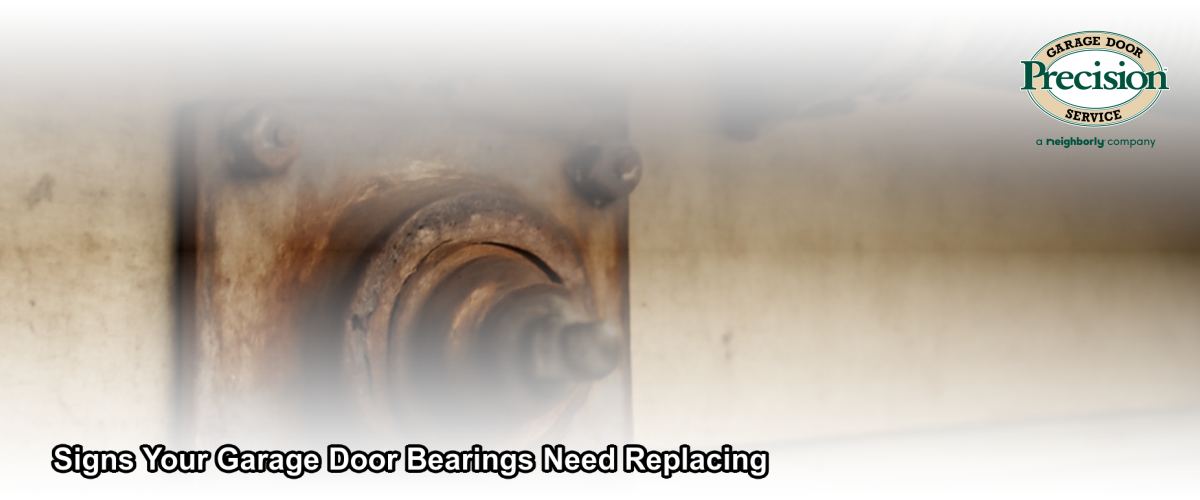
- Visible rust or corrosion on the bearing plate or the shaft area immediately around it
- A wobbling or off-center spring shaft — if the shaft visibly shifts during operation, the bearing is no longer holding it in alignment
- Excessive heat at the bearing plate after operation — a sign of metal-on-metal friction
If you notice any combination of these symptoms, do not ignore them. A seized bearing puts extra strain on your torsion springs, cables, and opener motor — turning a relatively straightforward bearing replacement into a potentially much costlier repair.
Can I confuse bearing noise with a different garage door problem?
Yes — grinding and squealing from a garage door can come from several sources, so accurate diagnosis matters before any parts are ordered. Worn rollers, a dry or bent track, a failing opener drive gear, or a spring that is losing tension can all produce sounds similar to bearing failure. That is why Precision Door Service of Central & South Jersey has every technician perform a comprehensive safety inspection during every service visit — not just a quick look at the obvious symptom — so the root cause is identified correctly the first time.
A good rule of thumb: if the noise is concentrated at the center of the door header (where the spring shaft sits) and happens consistently at the start of movement, bearings are the likely culprit. If the noise travels with the door as it moves, look at the rollers and tracks instead. Our full guide to garage door roller replacement covers that scenario in more detail.
How long do garage door bearings typically last?
Quality garage door bearings are generally rated for 10,000 cycles of use, which translates to roughly 7 to 10 years for a typical household. However, homes in coastal Ocean County and Monmouth County communities — including Point Pleasant Beach, Manasquan, and Seaside-adjacent towns — often see shorter lifespans due to salt air and humidity accelerating corrosion inside the bearing housing. In those environments, inspecting bearings every 3 to 5 years is a reasonable precaution rather than waiting for symptoms to appear.
Precision Door Service has been locally serving Central & South Jersey since 2000, and our experienced technicians see bearing wear show up earlier in shore-adjacent homes on a regular basis. If your home is within a mile or two of the bay or ocean, factor that into your maintenance timeline.
Is replacing garage door bearings a DIY job or should I call a professional?
Replacing garage door bearings is not a recommended DIY repair for most homeowners, because the bearings are integrated into the torsion spring system — one of the most dangerous components on any garage door. Torsion springs are under extreme tension; releasing or adjusting them incorrectly can cause serious injury. Even experienced handypeople who are comfortable with other home repairs should leave torsion spring work to trained professionals.
Precision Door Service of Central & South Jersey sends certified technicians who arrive stocked with high-quality replacement parts, perform the work safely, and explain every step before they begin. Our goal is always to do the right thing for the customer — which means honest recommendations, not upselling parts you do not need. As our technicians will tell you directly: if a bearing replacement is all that is required, that is all we will recommend.
What else is inspected or replaced at the same time as bearings?
When a technician replaces garage door bearings, it is the right moment to evaluate the condition of the components that work alongside them — because labor is already invested in the spring system area. Here is what a thorough technician should check at the same visit:
- Torsion springs — bearing failure accelerates spring wear; if the spring is within a year or two of its expected lifespan, replacing both at once saves a second service call
- Cable drums — drums sit adjacent to the bearing plates and can develop flat spots or corrosion
- Cables — frayed or kinked cables should be replaced before they snap
- Bearing plates — if the plate itself has grooved or distorted from a seized bearing, the plate needs to go too
- Lubrication of the full spring system — proper lubrication after bearing replacement extends the service life of every moving part nearby
This kind of proactive, all-in-one inspection is standard practice for every Precision Door Service visit. Catching a marginal spring or frayed cable during a bearing call can prevent an emergency breakdown — especially during New Jersey winters when frozen components and temperature swings put additional stress on the entire assembly. See our maintenance and safety inspection service for a full breakdown of what a comprehensive tune-up covers.
How often should I have my garage door inspected to catch bearing wear early?
Precision Door Service recommends a professional maintenance and safety inspection at least once a year for most homeowners in Ocean, Monmouth, Mercer, and Middlesex Counties. For high-use households — families cycling the door more than 5 to 6 times daily — or for homes in salt-air environments closer to the coast, a tune-up every 6 months is a smarter investment. Routine inspections catch bearing wear, cable fraying, and spring fatigue before they become emergency repairs, and they keep your door operating safely for everyone in the household.
A quick at-home check you can do between professional visits: stand inside your garage with the door closed, watch and listen as you operate it once through a full open-and-close cycle. Any new noise, any hesitation in the movement, or any visible wobble at the spring shaft is worth a call to our team.
Should I repair my bearings or replace the entire garage door?
Bearing replacement alone makes sense when the door panels, tracks, and opener are all in good condition — you are simply restoring a worn mechanical component in an otherwise sound system. If your door is older than 15 to 20 years, has significant panel damage, or has required multiple repairs in a short period, it may be more cost-effective to invest in a new door rather than continuing to service aging hardware. Precision Door Service offers free estimates on new garage door installation so homeowners can compare the costs honestly before deciding.
Our experienced technicians will always give you a straight answer on whether a repair or a replacement makes more financial sense for your situation — that customer-first approach is something we have built our reputation on across Central and South Jersey for more than 25 years.
This guide was prepared by the experienced technician team at Precision Door Service of Central & South Jersey, proudly serving homeowners in Ocean, Monmouth, Mercer, and Middlesex Counties from our offices in Brick and Milltown, NJ since 2000.
Frequently Asked Questions
What does it sound like when garage door bearings are going bad?
Failing garage door bearings most commonly produce a grinding, scraping, or high-pitched squealing noise that occurs at the start of the door’s movement cycle. The sound comes from the center of the door header where the torsion spring shaft sits, and it typically does not go away with lubrication alone — that is the key difference from a door that simply needs a routine tune-up.
How much does it cost to replace garage door bearings in New Jersey?
Precision Door Service of Central & South Jersey provides honest, upfront pricing after a comprehensive inspection — because bearing replacement cost depends on whether adjacent components like the spring, cables, or bearing plates also need attention. Contact our team at 732-836-9090 or visit precisiongaragedoorsnj.com for accurate pricing specific to your door and situation.
Can I replace garage door bearings myself?
Garage door bearing replacement is not a safe DIY project for most homeowners because the bearings are part of the torsion spring system, which operates under extreme tension and can cause serious injury if mishandled. A certified technician has the tools and training to release spring tension safely and replace bearings correctly.
How long do garage door bearings last in New Jersey coastal areas?
Standard garage door bearings are rated for roughly 10,000 cycles, or about 7 to 10 years for a typical household. In coastal communities near the Jersey Shore — such as Point Pleasant Beach or Brick — salt air and humidity can significantly shorten that lifespan, making inspections every 3 to 5 years a smart precaution.
Will a technician be able to replace my garage door bearings the same day they come out?
In most cases, yes — Precision Door Service technicians arrive stocked with high-quality replacement parts for the most common garage door repairs, including bearings, so same-day service is frequently possible. The technician will assess your specific door during the visit and explain exactly what is needed before any work begins.