What are garage door rollers and why do they matter?
Garage door rollers are the small wheeled components that ride inside the vertical and curved tracks on either side of your door, allowing it to open and close smoothly with every cycle. Without properly functioning rollers, even a perfectly balanced door will bind, shake, or produce grinding noises that signal bigger problems ahead.
Most residential garage doors use between 10 and 12 rollers, and those rollers endure thousands of cycles per year. A household that opens and closes the garage door 4 times a day puts its rollers through more than 1,400 cycles annually — which is exactly why roller quality directly affects how long your door operates quietly and reliably. As covered in our maintenance guide, rollers are one of the first components technicians inspect during a comprehensive safety inspection.
What is the difference between steel and nylon garage door rollers?
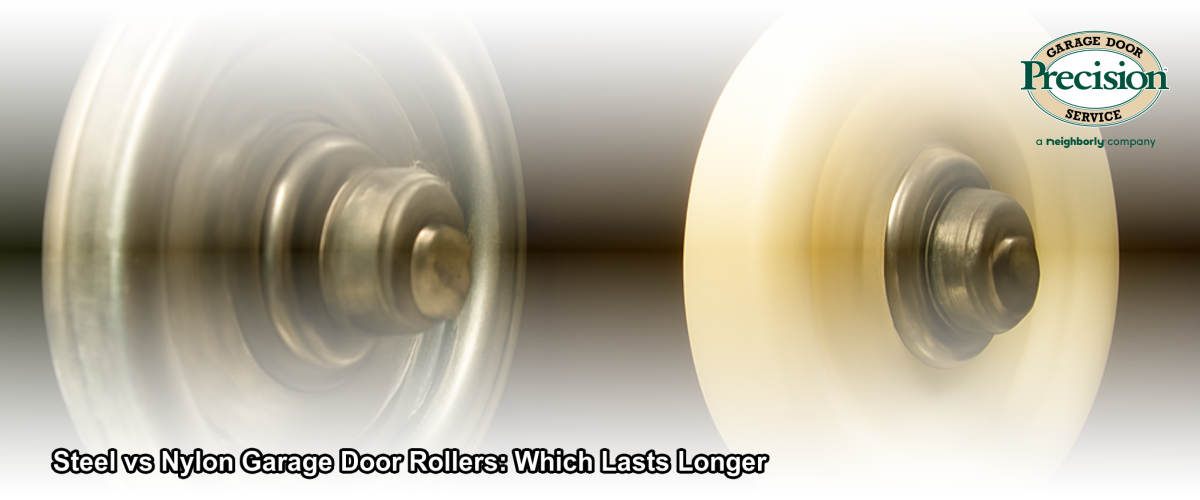
Steel rollers have a metal wheel that rides directly on the track, while nylon rollers use a hard polymer wheel — typically with steel ball bearings inside — that glides along the same track with significantly less friction and noise. The core material of the wheel is what separates them in performance, price, and longevity.
Steel rollers are the standard, lower-cost option found on many doors at the time of original installation. Nylon rollers with sealed ball bearings are the upgraded choice preferred by homeowners who want a quieter, longer-lasting result and are willing to invest a bit more upfront. In Central & South Jersey, where coastal humidity in communities like Brick, Point Pleasant Beach, and Toms River accelerates corrosion, the material choice matters even more than it does inland.
Which type of garage door roller lasts longer — steel or nylon?
Nylon rollers with sealed steel ball bearings consistently outlast standard steel rollers, typically delivering 10,000 to 20,000 cycles of reliable operation compared to 5,000 to 10,000 cycles for basic steel rollers without sealed bearings. That difference can translate to several additional years of service life under normal residential use.
Standard steel rollers without ball bearings wear faster because metal-on-metal contact generates friction that degrades the wheel and track surface over time. Once the nylon wheel is paired with sealed precision ball bearings, the rolling resistance drops dramatically and the sealed design keeps lubricant in and moisture out — a meaningful advantage in the salt-air environment along the Jersey Shore and Barnegat Bay.
How does coastal New Jersey weather affect roller lifespan?
Salt air, high humidity, and temperature swings common throughout Ocean and Monmouth Counties accelerate rust and corrosion on exposed metal components. Unsealed steel rollers are particularly vulnerable — the open bearing cavity collects moisture and salt particles, leading to pitting, seizing, and premature failure faster than you would see in a drier, inland climate.
Homeowners in Brick, Point Pleasant, Manahawkin, and Toms River should treat roller upgrades as a practical investment rather than an optional luxury. Nylon rollers with sealed bearings resist this corrosion far better, and regular lubrication — as recommended in our full maintenance guide — extends their life even further regardless of roller type.
Are nylon rollers quieter than steel rollers?
Yes — nylon rollers are noticeably quieter than steel rollers because the polymer wheel dampens vibration rather than transmitting it directly to the metal track and door panels. If your garage is attached to your home and opens into a bedroom wall or living space, the noise reduction alone is often reason enough to choose nylon.
Steel rollers, especially worn ones, produce the grinding, rattling, or squealing sounds that homeowners frequently describe when calling for a repair. In many cases, that noise is not a spring or opener problem — it is simply rollers that have reached the end of their useful life and need to be replaced. Our experienced technicians perform a comprehensive safety inspection on every visit and will identify whether noise is coming from rollers, tracks, or another component before recommending any repair.
How much do garage door roller replacements cost in Central & South Jersey?
Roller replacement costs vary based on the type of roller, the number of rollers being replaced, and any additional labor involved, but homeowners in the Precision Door Service area generally invest more in nylon rollers upfront in exchange for a longer service life and quieter operation. Precision Door Service uses high-quality parts on every job — we never cut corners with the cheapest available component just to lower the initial invoice.
Because pricing depends on your specific door configuration and the condition of surrounding hardware, Precision Door Service provides honest, transparent recommendations after a technician inspects the door in person. There are no surprise charges — your technician will clearly explain exactly what is needed and why before any work begins. Financing is also available through GreenSky via a simple online application for customers who prefer to spread out the cost of repairs or upgrades.
What hidden costs or additional repairs should I expect with roller replacement?
When rollers have been running rough for an extended period, they can cause secondary wear on the tracks — flattening or denting the rail where the damaged wheel repeatedly contacted it. In some cases, track adjustment or replacement becomes necessary alongside the roller swap. A thorough safety inspection will catch this before it becomes a more expensive problem.
You should also expect a lubrication service as part of any professional roller replacement — dry rollers and tracks accelerate wear on the new components immediately. Precision Door Service technicians include a safety inspection with every repair visit, so adjacent worn components like cables, springs, and hinges are evaluated at the same time rather than discovered separately on a follow-up call.
How do I know when my garage door rollers need to be replaced?
Rollers are due for replacement when you notice loud grinding or squealing during door operation, visible wobbling or shaking as the door moves, rollers that are cracked, chipped, or visibly worn flat, or a door that hesitates or jerks rather than gliding smoothly. Any of these signs means the rollers are no longer doing their job and are likely stressing other components in the process.
As a general guideline, most garage door manufacturers recommend inspecting rollers annually and replacing them every 5 to 7 years for standard steel rollers and every 10 to 15 years for quality nylon rollers — though actual lifespan depends heavily on usage frequency, lubrication habits, and local climate conditions. For Ocean and Monmouth County homeowners near the coast, erring toward the shorter end of that range is the more conservative and practical choice.
Should I replace garage door rollers myself or hire a professional?
Replacing the bottom rollers on a garage door can be a manageable DIY task for a mechanically confident homeowner, but replacing rollers near the bottom bracket — the bracket attached to the cable and spring system — is dangerous and should always be performed by an experienced technician. The spring system stores significant tension, and disturbing the bottom bracket while the door is under load can cause serious injury.
Precision Door Service technicians serving Brick, Toms River, Freehold, Princeton, Edison, and communities throughout Central & South Jersey are trained to handle the full replacement safely, correctly, and efficiently — often completing the job the same day as the initial service call. If you are already paying for a service visit, having a certified technician replace all rollers at once rather than a partial set is almost always the smarter long-term value. See our full guide to garage door maintenance for more on what a professional tune-up covers.
How often should garage door rollers be lubricated?
Garage door rollers should be lubricated approximately every 6 months as part of a regular maintenance routine — or at least once a year at a minimum. Use a lithium-based or silicone garage door lubricant applied directly to the roller stem and bearing, not the track itself. Lubricating the track interior is a common mistake that actually attracts dirt and grime, accelerating wear rather than reducing it.
Precision Door Service offers preventative maintenance and comprehensive safety inspections designed to keep your door operating safely and smoothly throughout the year. Our technicians service homeowners across Monmouth, Ocean, Mercer, and Middlesex Counties and can put you on a regular maintenance schedule so small issues like dry rollers never turn into emergency repairs.
This guide was prepared by the experienced technicians at Precision Door Service of Central & South Jersey, locally serving Central & South Jersey since 2000 from our offices in Brick and Milltown, NJ.
Frequently Asked Questions
How long do garage door rollers last?
Standard steel rollers typically last 5 to 7 years or roughly 5,000 to 10,000 cycles under normal use. Nylon rollers with sealed ball bearings can last 10 to 15 years or up to 20,000 cycles, making them the longer-lasting choice — especially in coastal New Jersey where humidity and salt air speed up corrosion on metal components.
Are nylon garage door rollers worth the extra cost?
For most Central and South Jersey homeowners, yes. Nylon rollers with sealed bearings run quieter, resist coastal humidity better, and outlast standard steel rollers by a significant margin. The higher upfront cost is typically offset by fewer replacements and less wear on surrounding hardware over time.
Can I replace garage door rollers myself?
Top and middle rollers can sometimes be swapped by a handy homeowner, but rollers near the bottom bracket — which connects to the cable and spring system — should only be replaced by a professional. Disturbing this area while the door is under spring tension is a serious injury risk.
Why is my garage door so loud — could it be the rollers?
Loud grinding, squealing, or rattling during door operation is one of the most common signs of worn or dry rollers. Before assuming the opener or springs are at fault, have a technician inspect the rollers — in many cases, replacing them and lubricating the system eliminates the noise entirely.
Does Precision Door Service replace rollers the same day?
In most cases, yes. Precision Door Service technicians carry high-quality replacement parts and can complete roller replacements during the initial service visit for homeowners throughout Ocean, Monmouth, Mercer, and Middlesex Counties.