
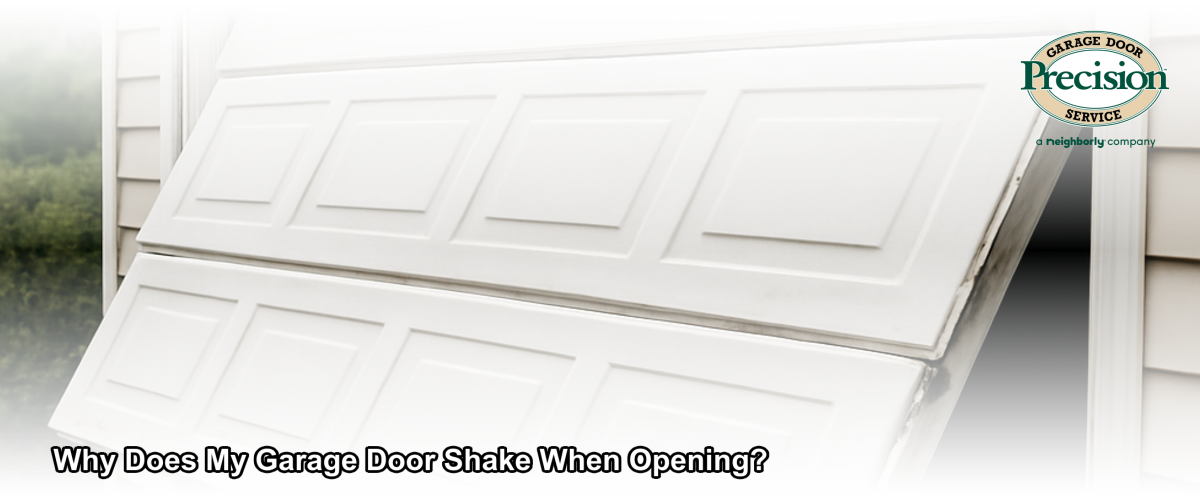
Why does my garage door shake or vibrate when it opens?
A garage door that shakes or vibrates when opening is almost always signaling worn, loose, or damaged components — and ignoring it typically leads to a more expensive repair down the road. The most common culprits are worn rollers, loose hardware, misaligned tracks, a struggling opener, or a door that has simply fallen out of balance. At Precision Door Service of Central & South Jersey, our experienced technicians have diagnosed this exact problem in homes across Ocean, Monmouth, Mercer, and Middlesex Counties for more than 25 years, and it is almost always fixable in a single visit.
This guide walks through each cause clearly so you know what you are dealing with before a technician arrives — or before you decide whether to call one at all.
Could worn or damaged rollers be causing my garage door to vibrate?
Yes — worn rollers are one of the single most common reasons a garage door shakes, and they are one of the first things a technician should check. Rollers are the small wheels that ride inside your garage door tracks, and when their bearings wear out or the wheels themselves crack and chip, every movement of the door becomes rough and noisy rather than smooth and quiet.
Standard nylon or steel rollers have a typical service life of 7 to 12 years depending on use and maintenance. Coastal homeowners in towns like Point Pleasant Beach, Manasquan, or anywhere near the Barnegat Bay should be aware that salt air accelerates corrosion on steel rollers, shortening that lifespan noticeably. Replacing worn rollers with high-quality nylon rollers is a straightforward repair that makes an immediate, noticeable difference in how smoothly and quietly your door operates.
Can loose hardware make a garage door shake when it opens?
Loose bolts, brackets, and hinges are a surprisingly common source of garage door vibration, and they are easy to overlook because the door still technically opens and closes. Over time, the repeated mechanical stress of hundreds of open-and-close cycles each year causes hardware to work itself loose — especially on doors that have never been professionally maintained.
Key hardware points to check include the hinge brackets connecting each panel, the lag bolts securing the track to the wall, and the fasteners holding the opener rail to the header bracket above the door. A loose bracket transfers vibration directly to the door panels and the surrounding frame, making the whole system feel unstable. As part of every repair visit, Precision Door Service of Central & South Jersey technicians perform a comprehensive safety inspection that includes checking and tightening hardware — not just fixing the one thing you called about.
What role do misaligned or bent tracks play in a shaking garage door?
Misaligned or bent tracks force the rollers to fight the path they are riding in, which causes the door to jerk, skip, and vibrate with every pass. Tracks can fall out of alignment gradually from hardware loosening over time, or suddenly from an impact — a bumped car, a settled foundation, or a hard freeze followed by a thaw, all of which are realities for homeowners in Central and South Jersey.
A track that is even a small fraction of an inch out of plumb can create significant vibration. Bent sections are a more serious issue and usually require track replacement rather than adjustment. Never attempt to hammer a bent track back into shape yourself — tracks are under spring tension and can be hazardous to handle without proper training and tools. Our technicians are equipped to assess and correct track issues on the same visit in most cases, so your door is operating safely before we leave.
Could my garage door opener be the source of the vibration?
A failing or aging garage door opener can absolutely cause vibration, particularly chain-drive openers whose chains have stretched and begun to sag. A loose or improperly tensioned chain slaps against the rail during operation, sending vibration through the entire system. Similarly, worn drive gears and sprockets inside the opener motor unit create rough, uneven motion that you feel as a shake or shudder.
Belt-drive openers are significantly quieter and smoother than chain-drive models, and many homeowners in communities throughout Monmouth and Ocean Counties have upgraded to a belt-drive or wall-mounted LiftMaster or Genie opener specifically to eliminate vibration and noise — especially in homes with living space above or adjacent to the garage. If your opener is more than 10 to 15 years old and causing vibration, replacement may be more cost-effective than repeated repairs. Precision Door Service offers repair, replacement, and installation of LiftMaster and Genie openers, including Wi-Fi-connected models with battery backup — useful during the power outages that accompany nor’easters and summer storms along the Jersey Shore.
What happens if my garage door is out of balance?
An unbalanced garage door puts uneven strain on every component in the system, and that uneven strain manifests as shaking, jerking, or a door that moves faster on one side than the other. Balance is maintained primarily by the torsion or extension springs above the door — when one spring is weakened, broken, or incorrectly tensioned, the door becomes lopsided under operation.
You can do a quick informal balance check by disconnecting the opener and manually lifting the door to about waist height, then letting go. A properly balanced door should stay in place or drift only slightly. If it drops or shoots upward, the springs need professional attention. Do not attempt to adjust or replace garage door springs yourself — they are under extreme tension and a leading cause of serious injury among DIY repair attempts. Our certified technicians at Precision Door Service handle spring repairs and replacements safely and correctly every time.
Can lack of lubrication cause a garage door to shake?
Yes — insufficient lubrication is one of the most overlooked and easiest-to-fix causes of garage door noise and vibration. Metal components that run dry — rollers, hinges, springs, and tracks — create friction, and that friction produces both sound and movement that feels like a shake or shudder. In New Jersey, where temperatures swing from humid summers to freezing winters, lubricant breaks down faster and needs replenishment more regularly than homeowners in milder climates.
Garage doors should be lubricated with a dedicated garage door lubricant (not WD-40, which strips rather than lubricates) roughly once or twice per year, ideally in spring and late fall. As covered in our maintenance guide, a proper tune-up includes lubrication along with a full inspection — and it is one of the most cost-effective ways to prevent the kind of wear that causes shaking and vibration in the first place. Precision Door Service of Central & South Jersey offers preventative maintenance and safety inspections specifically designed to catch these issues before they become breakdowns.
Should I try to fix a shaking garage door myself, or call a professional?
For most causes of garage door vibration, professional service is the safer and more reliable choice — but the right answer depends on what is actually wrong. Tightening visible loose bolts with a socket wrench and applying fresh lubricant are reasonable DIY tasks for a careful homeowner. Everything else — adjusting or replacing springs, realigning tracks, repairing opener drive components, or replacing rollers — involves either spring tension, precise alignment work, or both, and is best left to an experienced technician.
Attempting spring or track work without proper training is genuinely dangerous, and a repair done incorrectly can damage panels, bend tracks further, or cause the door to come off its tracks entirely. Our goal at Precision Door Service is always to do the right thing for the customer — that means giving you an honest assessment of what actually needs fixing, not upselling parts you do not need. We are here when you need us, anytime, every time, with 24/7 availability for urgent repairs across Ocean, Monmouth, Mercer, and Middlesex Counties.
What does it cost to fix a shaking or vibrating garage door in Central or South Jersey?
The cost depends entirely on which component is causing the vibration, since the range between a simple lubrication service and a full spring or opener replacement is significant. Here is a realistic picture of what homeowners in Central and South Jersey typically encounter:
- Lubrication and hardware tightening — typically the lowest-cost service, often included in a maintenance visit
- Roller replacement — cost varies based on the number of rollers and material (nylon vs. steel); a full set replacement is a common and affordable fix
- Track realignment — labor-based cost that depends on severity; minor adjustments are straightforward, bent track replacement adds parts cost
- Spring replacement — torsion and extension springs vary in price by size and type; always replace both springs at the same time for balanced operation
- Opener replacement — belt-drive and wall-mounted LiftMaster or Genie models vary by features; Wi-Fi and battery backup units are priced higher than basic models
Precision Door Service provides free estimates for new door installations, and our technicians explain all recommended repairs and their costs clearly before any work begins — no surprises. Financing is also available through GreenSky with an easy online application for larger repairs or replacements.
What hidden costs or extras should I expect during a garage door vibration repair?
Transparency matters, so here is what to expect beyond the obvious repair itself. When a technician visits for vibration, they will perform a comprehensive safety inspection of the full system — not just the component that caused you to call. That inspection sometimes reveals secondary issues: a frayed cable, a roller that was about to fail, or a spring showing end-of-life wear. You will always be told what was found and given the option to address it, with no pressure to do more than you are comfortable with.
Parts quality matters here too. Precision Door Service uses high-quality replacement parts, which means you are not paying to have the same part fail again six months later. If you are in an area close to the shore — Point Pleasant Beach, Seaside Heights, Lavallette — ask your technician specifically about corrosion-resistant hardware, since standard steel components degrade faster in salt-air environments. That is the kind of honest, localized recommendation we believe every customer deserves.
This guide was prepared by the experienced technician team at Precision Door Service of Central & South Jersey, locally serving Ocean, Monmouth, Mercer, and Middlesex Counties since 2000.
Frequently Asked Questions
Why does my garage door shake when it opens or closes?
A shaking garage door is most commonly caused by worn rollers, loose hardware, misaligned tracks, an aging opener, unbalanced springs, or lack of lubrication. A professional inspection identifies the exact cause so the right fix is made the first time.
Is a vibrating garage door dangerous to use?
A mildly vibrating door may be safe temporarily, but continued use accelerates wear on other components and can lead to a sudden failure — including a door that comes off its tracks or a broken spring. It is best to have it inspected promptly rather than waiting for it to stop working entirely.
How long do garage door rollers last before they cause vibration?
Most garage door rollers last between 7 and 12 years depending on use and maintenance. Rollers in coastal New Jersey communities near the ocean or bay may wear faster due to salt-air corrosion, particularly steel rollers.
Can I fix a shaking garage door myself?
Tightening loose bolts and applying fresh lubricant are safe DIY tasks. However, adjusting springs, realigning tracks, or repairing opener components involves spring tension and precision work that should be handled by an experienced technician to avoid injury or further damage.
How often should I have my garage door maintained to prevent shaking and vibration?
Most manufacturers and garage door professionals recommend a tune-up and safety inspection once a year, with lubrication applied every six months. Annual maintenance catches worn rollers, loose hardware, and spring wear before they develop into the kind of vibration and noise that signals a more serious problem.